HBM4 Arrives: How AI Memory Is Reshaping DRAM in 2026
The reason your DDR5 kit costs four times what it did eighteen months ago is stacked, literally, next to a GPU: high-bandwidth memory. As HBM4 ramps through 2026, the HBM4 vs HBM3 transition is doing more than upgrading AI accelerators — it is restructuring the entire DRAM industry, redirecting fab capacity, and repricing the memory in your PC.
To understand why a data-center memory standard dictates what you pay for desktop RAM, you need to understand what changed between generations, how much silicon each AI GPU consumes, and why the economics make your DDR5 the industry's afterthought.
HBM4 vs HBM3: what's actually new
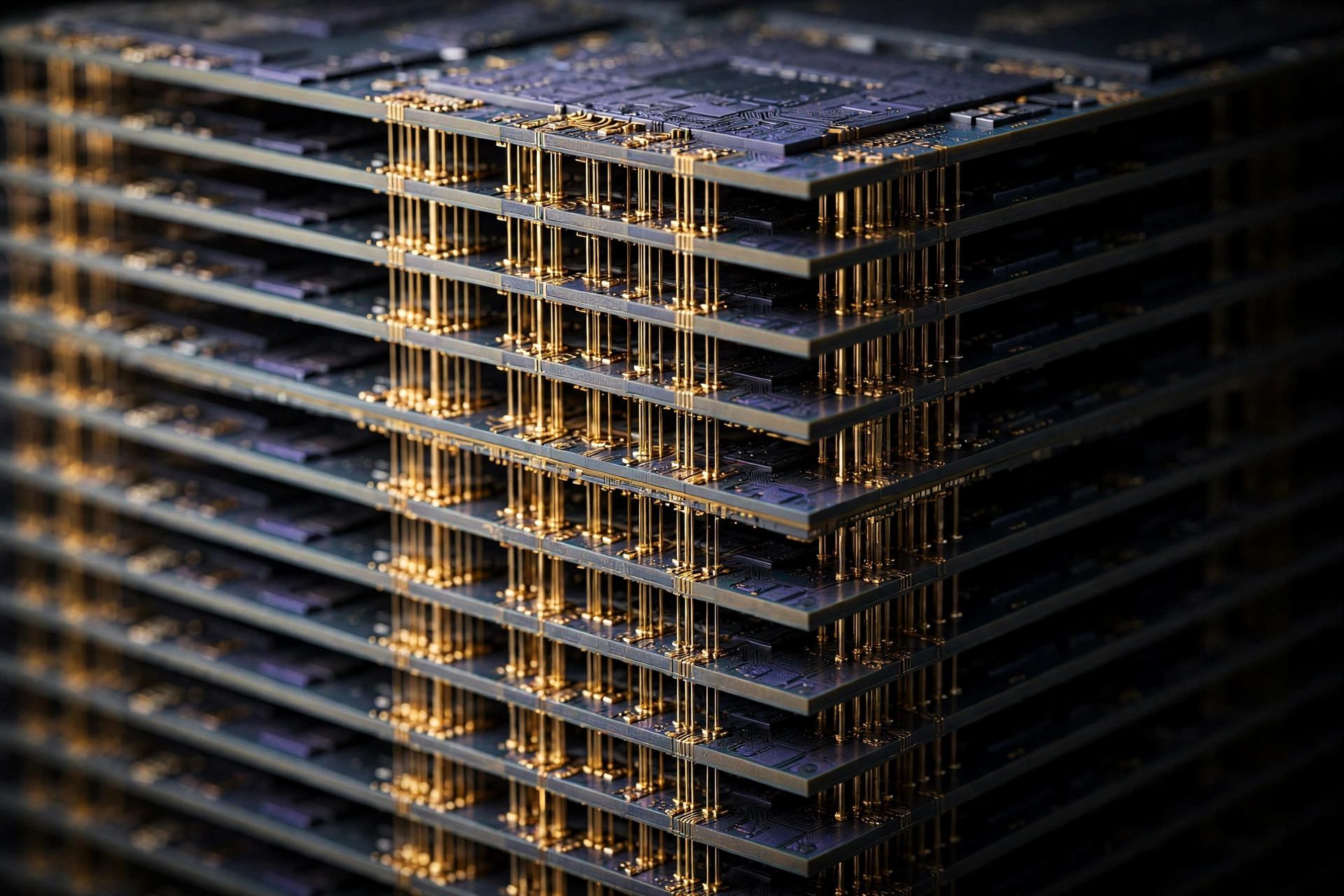
High-bandwidth memory stacks DRAM dies vertically and connects them to the processor through an interposer, trading the narrow, fast DIMM interface for an enormously wide, power-efficient one. Each generation widens the interface, stacks more dies, and pushes per-stack bandwidth higher. HBM4 is the biggest generational leap yet:
| Specification | HBM3 | HBM3E | HBM4 |
|---|---|---|---|
| Interface width per stack | 1024-bit | 1024-bit | 2048-bit |
| Bandwidth per stack (approx.) | ~819 GB/s | ~1.2 TB/s | ~2 TB/s+ |
| Typical stack height | 8–12 dies | 8–12 dies | 12–16 dies |
| Capacity per stack | 16–24 GB | 24–36 GB | 32 GB+ |
| Integration | Interposer | Interposer | Advanced packaging, tighter logic-die coupling |
The headline change is the doubled 2048-bit interface, but the capacity story matters just as much for the DRAM market. A 12-to-16-high HBM4 stack holds dramatically more silicon than its predecessors — and every one of those dies is a DRAM die that came out of the same wafer starts, the same cleanrooms, and the same process engineering talent that would otherwise produce commodity DDR5. Tighter integration with AI accelerators via advanced packaging also means HBM4 production is more complex and lower-yielding in its ramp phase, consuming disproportionate engineering attention from the three DRAM makers.
The generational cadence tells its own story: HBM3E was essentially a speed-binned refinement, while HBM4 is an architectural step. That step coincides with the largest AI infrastructure buildout in history, which is why the market impact lands all at once in 2026 rather than phasing in gradually.
Each AI GPU eats a wafer budget
Here is the arithmetic that explains your DDR5 prices. A flagship AI accelerator now ships with multiple HBM4 stacks — commonly six to eight — totaling well over 200 GB of stacked memory per GPU. At 12–16 dies per stack, a single accelerator can contain on the order of a hundred DRAM dies before you count a single byte of DDR5, LPDDR, or GDDR anywhere else in the system.
Multiply that by millions of accelerators. Hyperscaler buildout plans for 2026 run to millions of AI GPUs, each one a small DRAM fab's worth of output in stacked form. The three DRAM manufacturers — Samsung, SK hynix, and Micron — allocate wafers where margins are highest, and HBM margins dwarf commodity DDR5 by multiples. The result is the defining dynamic of 2026: conventional DRAM contract prices nearly doubled quarter-on-quarter in Q1 (TrendForce), not because PCs suddenly need more memory, but because fabs are busy building memory for data centers instead.
This is not a temporary allocation quirk. HBM requires the most advanced process nodes, the most careful binning, and dedicated packaging lines. Once a maker commits wafer starts and packaging capacity to HBM4, that capacity is spoken for across multi-year supply agreements with accelerator vendors. Commodity DRAM gets what is left.
The capacity squeeze in numbers
The squeeze shows up across every price series the industry publishes. Conventional DRAM contract pricing nearly doubled in a single quarter to open 2026. DDR5 retail kits — the best DDR5 RAM picks that sold at historic lows in late 2024 — now cost multiples of those prices, with the increases steepest at higher capacities and speeds where supply is thinnest.
The pain extends beyond DRAM. Even large memory module makers have pointed to NAND wafer costs up 246% since early 2025 as the industry reprices around AI demand — memory of every type is being pulled into the AI gravity well. Our 2026 memory price surge tracker follows both the DRAM and NAND price action in detail, quarter by quarter.
What makes 2026 historically unusual is the simultaneity: DRAM squeezed by HBM wafer allocation, NAND squeezed by deliberate output cuts and enterprise SSD demand. In past cycles, one memory type would be tight while the other was loose, giving builders somewhere to save. This time both are tight at once, which is why total system memory-and-storage costs have risen faster than in any cycle of the last fifteen years.
Who this matters for: winners and losers
The winners are the three DRAM makers, posting record memory revenues on the back of HBM pricing power. HBM4 commands a substantial premium per bit over commodity DRAM, and long-term supply agreements with accelerator vendors lock in that premium for years. For Samsung, SK hynix, and Micron, the AI era is the most profitable memory market ever — which is precisely why they have no incentive to rebalance toward cheap DDR5.
The losers are everyone downstream. PC builders face memory costs that blow up bill-of-materials math planned even a year ago. OEMs are quietly shipping lower memory configurations at the same price points — the 8GB laptop is creeping back in segments where 16GB had become standard. Consumers pay the scarcity premium directly, and the used market offers little relief since older DDR4 systems cannot use DDR5 anyway.
Data-center operators sit in the middle: they pay record prices for HBM4, but they pass those costs to AI customers who currently absorb them. The tension resolves only if AI revenue growth ever stops justifying the infrastructure spend — the single biggest downside risk to the entire memory supercycle.
What it means for your next PC build
Practical guidance for builders navigating the squeeze. First, do not overbuy memory you will not use — every gigabyte has a real cost now. Our how much RAM you need in 2026 guide breaks down realistic requirements by workload; most gamers are still fine at 32GB, and paying the premium for 64GB "for the future" is a worse trade than it has ever been.
Second, reconsider DDR4 if your platform allows it. For existing DDR4 systems, a cheap capacity bump on the old standard beats an expensive platform migration. Our DDR5 vs DDR4 in 2026 comparison runs the numbers: DDR5's bandwidth advantage is real but narrow for most workloads, and the price gap has rarely been wider.
Third, time purchases around platform launches, not memory prices. Memory prices are not coming back down soon (see below), so waiting for cheaper RAM before building is a losing strategy. Buy the memory your build needs when you build; the "deal" you are waiting for is not on the horizon.
Does it end?
HBM demand is not a bubble in the traditional sense — AI infrastructure buildout has multi-year visibility backed by hyperscaler capital expenditure plans, not speculative leverage. The demand is real, funded, and contracted years ahead. That is what makes this cycle structurally different from crypto-driven GPU shortages, which evaporated when prices turned.
Relief comes from two sources, and both take years. New fab capacity — additional cleanrooms, more wafer starts — is the durable fix, but leading-edge DRAM fabs take three to five years from groundbreaking to volume output, and current expansion plans are sized for HBM first. Process shrinks improve bits per wafer, but each successive shrink is harder and more expensive than the last, and the gains flow to HBM margins before they reach commodity pricing.
For the foreseeable future, consumer DRAM lives in HBM's shadow. The 2020s taught buyers to expect memory as a cheap, abundant commodity; the rest of the decade will teach the opposite. Expect structurally higher prices than the last decade normalized — not as a spike to wait out, but as the market clearing price of an industry whose best customers are data centers.
FAQ
What is the difference between HBM4 and HBM3?
HBM4 doubles the per-stack interface to 2048-bit (from 1024-bit in HBM3/HBM3E), pushing per-stack bandwidth past 2 TB/s, stacks more dies (12–16 high), and integrates more tightly with AI accelerators through advanced packaging. It is an architectural step, not a speed bin — which is why its market impact is so much larger than the HBM3-to-HBM3E transition.
Why does HBM4 make my DDR5 more expensive?
Because HBM4 consumes the same fab capacity — wafer starts, process engineers, packaging lines — that would otherwise produce commodity DRAM. Makers allocate capacity to the highest-margin product, and HBM margins dwarf DDR5. Less DDR5 supply against steady demand means higher prices; conventional DRAM contract prices nearly doubled quarter-on-quarter in Q1 2026.
Should I wait for DDR5 prices to come down before upgrading?
No. The price pressure comes from multi-year AI infrastructure contracts and fab capacity committed to HBM, neither of which unwinds quickly. If you need the memory, buy what your workload requires now — our RAM sizing guide can keep you from overbuying at these prices.
Is DDR4 a sensible alternative in 2026?
For existing DDR4 platforms, absolutely — a capacity bump on cheap DDR4 beats an expensive DDR5 platform migration for most workloads. For new builds, DDR5 is still the right choice for platform longevity, but buy only the capacity you need and skip the premium speed bins unless your workload benefits.
Will new fabs fix the memory shortage?
Eventually, but not soon. Leading-edge DRAM fabs take years from groundbreaking to volume production, and current expansion is prioritized for HBM capacity. Process shrinks help at the margin. Realistically, structurally elevated memory pricing persists through the decade's second half.
Bottom line: Every HBM4 stack in a data center is DDR5 that never got made. The HBM4 vs HBM3 leap doubled bandwidth per stack and deepened AI's claim on the world's DRAM fabs — and until capacity catches up with multi-year AI demand, expensive memory is not a glitch. It is the market, and builders should plan around it rather than wait it out.