OCP Summit 2026 Storage Preview: Kioxia's 122TB-Ready E1.L SSD and the Hyperscale Density Race
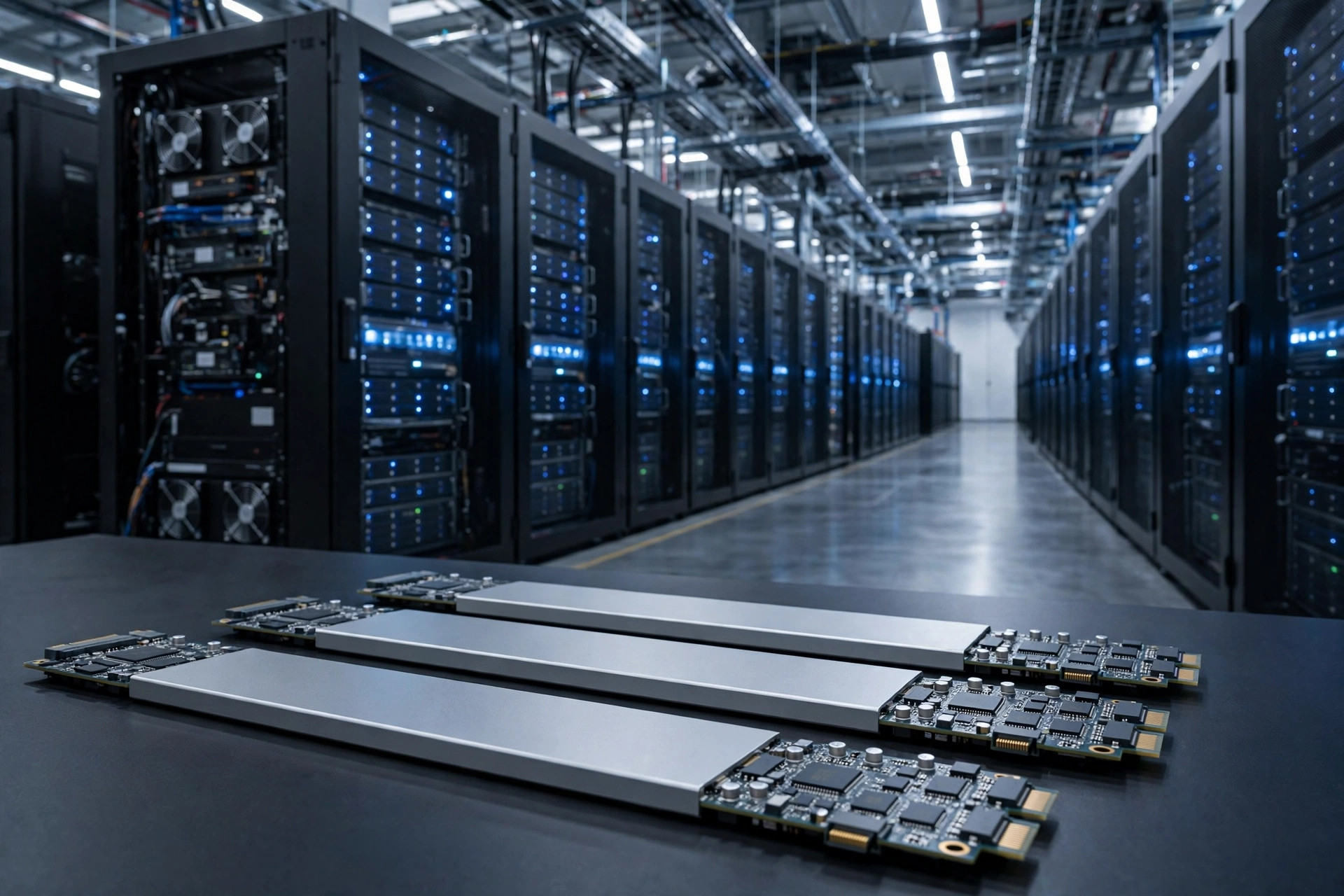
The OCP Global Summit 2026 opens tomorrow — October 12–15 at the San Jose Convention Center — and this year's storage story is density. Days before the doors open, Kioxia announced the LD4 series: its first SSD in the E1.L "ruler" form factor, built on BiCS FLASH generation 8 QLC, with an architecture validated all the way to 122.88TB per drive.
For anyone who specs, buys, or simply watches enterprise storage, this is the announcement to understand before the summit keynotes start. It says a lot about where hyperscale storage is going: thinner drives, more terabytes per rack unit, QLC flash moving deeper into the data center, and PCIe 5.0 holding the line while the industry figures out Gen6. Here is what the LD4 actually is, why the form factor matters as much as the flash, and what to watch for during the summit.
The headline: a 122TB-ready ruler SSD
The LD4 is Kioxia's first E1.L drive and carries the company's "D" series designation — the letter Kioxia reserves for hyperscale-oriented products. It is aimed squarely at read-intensive workloads in high-density 1U scale-out servers: the machines that serve AI training data, content libraries, and warm object storage at cloud scale.
The drive is currently sampling to select customers — meaning early units are in partners' hands for functional evaluation — and it will be showcased on the floor at the OCP Global Summit. One honest footnote from the announcement: the sampling units are for functional checks and mass-production specifications may differ. Treat every number below as the launch specification, not a shipping guarantee.
LD4 specifications at a glance
| Specification | Kioxia LD4 |
|---|---|
| Form factor | E1.L (ruler), 9.5mm × 318.75mm |
| NAND | BiCS FLASH generation 8 QLC (218 layers) |
| Interface | PCIe 5.0 x4 (16 GT/s), NVMe 2.0e |
| OCP compliance | OCP Datacenter NVMe SSD Specification v2.6 |
| Port configuration | Single-port |
| Launch capacities | 15.36TB, 30.72TB |
| Validated architecture | Up to 122.88TB |
| Sequential read | Up to 14,000 MB/s (reported) |
| Sequential write | Up to 3,500 MB/s (reported) |
| Random read / write | 1.6M IOPS / 45,000 IOPS (reported) |
| Power | 25W active, 7W idle (reported) |
| Endurance | 1 DWPD |
| Availability | Sampling now; mass production TBA |
The headline number is the 122.88TB validation: the drive launches at 15.36TB and 30.72TB, but the platform is engineered to scale to four times the launch capacity. That is the hyperscale density race in a single spec line.
Why E1.L, and why now
E1.L is a ruler-shaped module — long, thin, and designed to mount so cooling air flows along its full length. At 9.5mm thick and 318.75mm long, it extends PCB depth to pack far more NAND packages into a 1U chassis than a 2.5-inch drive ever could. Two 30.72TB drives occupy minimal front-panel area, which matters in front-cabled server designs and ORv3 racks where rear-mounted power, liquid cooling, and in-rack interconnects compete for every millimeter.
The geometry solves two problems at once. First, density: more flash sites per rack unit means more terabytes behind the same front panel. Second, thermals: components sit directly in the airstream instead of behind a wall of neighboring drives, so a 25W drive can sustain its performance without heroic fan curves. If you want the full family picture — how E1.L relates to E1.S, E3.S, and the incumbent U.2 — our enterprise SSD form factor explainer covers the trade-offs in detail.
E1.L vs the enterprise incumbents
| Attribute | U.2 (2.5", 15mm) | EDSFF E3.S | E1.L (ruler) |
|---|---|---|---|
| Target buyer | Enterprise fleets | Enterprise / cloud | Hyperscale |
| Density per rack unit | Good | Better | Best in class |
| Per-drive capacity ceiling | ~30–60TB class | ~30–60TB class | 122.88TB validated |
| Typical drive power | ~25W practical | Up to 70W (2T) | ~25W class |
| Hot-swap | Yes | Yes | Yes |
| Ecosystem maturity | Decade of playbooks | Growing fast | Hyperscaler-driven |
The table tells the strategic story: U.2 wins on operational familiarity, E3.S on balanced enterprise thermals, and E1.L on raw density for operators who buy storage by the petabyte and count rack units like currency.
QLC grows up: the 1-DWPD bargain
QLC stores four bits per cell, which buys enormous density at the cost of write endurance and latency. The LD4 leans all the way into that compromise: sequential reads hit a reported 14,000 MB/s while sequential writes land at 3,500 MB/s, and random writes top out at 45,000 IOPS against 1.6 million random read IOPS. The asymmetry is the point — this drive is built for workloads that are read 95% of the time.
The endurance rating is 1 drive write per day (DWPD). On a 30.72TB drive, that means roughly 30TB of writes per day, every day, for the warranty period — about 56 petabytes total over five years. For AI inference serving, video delivery, and backup staging, that is plenty. For write-heavy databases, it is disqualifying. The NAND inside matters more than the connector, which is why we wrote a dedicated TLC vs QLC endurance guide — and if you are speccing drives by workload, our DWPD explainer for the AI era shows how to match endurance class to the job.
Under the hood, BiCS generation 8 QLC stacks 218 layers, and Kioxia has pointed to a 4-plane die architecture that uses parallelism to soften QLC's inherent write penalty. More planes mean more simultaneous operations, which is how a QLC drive posts 1.6M read IOPS despite the physics of four-bits-per-cell.
PCIe 5.0, not Gen6 — deliberately
One detail worth noticing: the LD4 is PCIe 5.0 x4, not Gen6. That is a conscious choice, not a lag. Storage applications — particularly QLC-based ones — transition to new PCIe generations more slowly than GPU-attached devices, because flash arrays rarely saturate even a Gen5 x4 link on the workloads they actually serve. A single-port Gen5 design is cheaper, cooler, and fully interoperable with the installed base of 1U servers.
More telling is the OCP Datacenter NVMe SSD Specification v2.6 compliance. OCP's spec is the hyperscalers' common language for drive behavior — telemetry, thermal management, firmware update flows. Supporting it signals exactly who this drive is for: operators who qualify drives against an open standard, not a vendor's datasheet. Expect the summit floor to be full of v2.6-compliant launches; the LD4 is just the first headline.
Reading the spec sheet like a hyperscaler
Three lines on the LD4 spec sheet deserve a second look, because they reveal how hyperscalers evaluate drives:
- Single-port, not dual-port. Dual-port drives exist for high-availability failover paths. A single-port design says the target customer handles redundancy at the system or rack level — erasure coding across nodes — rather than paying for it in every drive. It is cheaper per terabyte and a deliberate philosophical choice.
- 25W active, 7W idle. At data-center scale, idle power matters as much as active power, because fleets spend most of their lives nowhere near full load. The 7W idle figure is what the facility's power budget actually feels across tens of thousands of drives.
- NVMe 2.0e. The "e" revision streamlines the specification for simpler implementations. For a read-optimized QLC drive, supporting the full enterprise feature set would add controller complexity — and cost — with no workload benefit. Restrained spec compliance is a cost decision disguised as a technical one.
None of these choices make the drive better in a benchmark. All of them make it cheaper per petabyte deployed — which is the only benchmark that matters to the buyer it was built for.
The density race in context
The LD4's 122.88TB validation lands in the middle of a multi-year capacity sprint:
| Era | Milestone | What changed |
|---|---|---|
| 2020 | First 100TB-class SSD | Proved the market for ultra-high-capacity flash |
| 2023 | 61.44TB generation | QLC + 200+ layer NAND made 60TB economical; multiple vendors shipped |
| 2024 | First 122.88TB drive | The density crown doubled in a single generation |
| 2026 | LD4 validated to 122.88TB in E1.L | 122TB-class capacity moves into the densest ruler form factor |
The pattern is consistent: each NAND generation roughly doubles the economical capacity ceiling, and the form factor evolves to keep thermals and serviceability viable at the new density. E1.L is the 2026 answer to the question "where do we put 122TB without melting it."
The competitive backdrop
Kioxia is not entering an empty field. The 122.88TB club already has members: Solidigm's D5-P5336 pushed the industry to 122.88TB in 2024, and the 61.44TB generation — Samsung's BM1743 among others — made 60TB-class QLC a mainstream hyperscale building block in 2023. What the LD4 changes is the packaging of that capacity class: 122TB validated in the E1.L ruler rather than the U.2 brick.
That distinction matters because of density economics. A hyperscaler does not just buy terabytes; it buys terabytes per rack unit, per watt, and per failure domain. Fewer, denser drives mean fewer drive slots to populate, less interconnect overhead per petabyte, and fewer devices to monitor and replace. When a single E1.L module can eventually hold 122.88TB, a single 1U node crosses into multi-petabyte territory — the kind of density that lets operators defer entire data-hall builds.
The other competitive axis is the NAND itself. BiCS generation 8 is Kioxia's 218-layer QLC, and the layer-count race — 200+ layers across all major vendors — is what makes these capacities economical in the first place. More layers per wafer means more bits per silicon dollar, which is the quiet engine behind every row in the timeline table above. Whoever ships the most layers at the best yield sets the price floor for the whole density tier.
What to watch at the summit
The LD4 is the storage headline, but three other exhibitor threads are worth tracking for what they say about where storage bottlenecks are moving:
- 1.6T interconnect (Credo, booth B2): optical and copper interconnects for AI fabrics — including PCIe rack-level connectivity for GPU-heavy workloads. When the network between storage and compute gets faster, the pressure shifts onto the drives to keep up.
- CXL memory expansion (Marvell, booth B31): memory expansion and acceleration pitched as the answer to the "memory wall." Watch how CXL-attached memory is positioned relative to QLC flash — the industry is still negotiating which tier holds warm data.
- Validation at scale (Keysight, booth C83): large-scale AI workload emulation and multi-vendor interoperability testing. As open standards like the OCP DC NVMe SSD spec spread, the ability to validate mixed-vendor deployments before rollout becomes the gating factor for adoption.
The through-line: AI infrastructure is moving from individual fast components to validated, interoperable systems. A drive is no longer evaluated alone — it is evaluated as part of a rack the hyperscaler can deploy ten thousand of without surprises.
What it means for buyers
Enterprise and hyperscale buyers: the LD4 is a sampling-stage product. The right move is to get it into your qualification pipeline if you run read-intensive 1U fleets — and to watch what competitors announce at the summit before committing roadmaps. Samples are for functional checks; mass-production specs may differ, so treat performance figures as directional until qualified units ship. As a rule of thumb, enterprise SSDs typically take several quarters from first sampling to volume availability, with hyperscale qualification — thermal validation, firmware hardening, fleet-level failure analysis — consuming most of that time. An announcement in October 2026 realistically points to meaningful volume in the second half of 2027, assuming qualification goes smoothly.
Everyone else: you will never buy an E1.L drive, and that is fine. The density race still reaches you indirectly: every generation that pushes more terabytes into the data center increases NAND output efficiency, and that supply eventually shows up in the consumer drives you actually buy. When 122TB becomes a normal hyperscale building block, the cost curve for the 4TB and 8TB drives on your wishlist bends downward — usually with a one-to-two-year lag.
FAQ
What is the OCP Global Summit?
The Open Compute Project's annual conference, where hyperscalers, vendors, and operators align on open hardware standards for data centers. The 2026 edition runs October 12–15 at the San Jose Convention Center in California. Storage, networking, and AI infrastructure announcements cluster here because the audience is the people who actually deploy at scale.
What is the Kioxia LD4?
Kioxia's first SSD in the E1.L ruler form factor, built on BiCS FLASH generation 8 QLC NAND. It launches at 15.36TB and 30.72TB with an architecture validated to 122.88TB, targets read-intensive hyperscale workloads in 1U servers, and is currently sampling to select customers.
What does E1.L mean?
E1.L is a member of the EDSFF (Enterprise and Datacenter SSD Form Factor) family — a long, thin "ruler" module measuring 9.5mm thick by 318.75mm long. The shape maximizes NAND packages per rack unit and puts components directly in the cooling airstream. It is the density-first choice for hyperscale operators.
Is 122.88TB available now?
No. The LD4 launches at 15.36TB and 30.72TB; 122.88TB is the validated architecture ceiling, meaning the platform is engineered to reach it in future configurations. Think of it as a roadmap commitment backed by engineering validation, not a SKU you can order today.
Why QLC instead of TLC for a flagship drive?
Because the target workloads barely write. QLC's weakness is write endurance and write speed; its strength is capacity per dollar. For read-intensive applications — AI data serving, content delivery, warm object storage — QLC delivers far more terabytes per rack unit at an acceptable endurance trade-off. Write-heavy workloads should still choose TLC or higher-endurance classes.
What does 1 DWPD mean in practice?
One drive write per day: you can rewrite the drive's entire capacity daily for the warranty period. On the 30.72TB LD4, that is about 30TB of writes per day, or roughly 56 petabytes over five years. Generous for read-heavy use; insufficient for write-intensive databases.
Why PCIe 5.0 and not PCIe 6.0?
Flash-based storage rarely saturates a Gen5 x4 link on real workloads, and Gen5 keeps power, cost, and compatibility with the installed server base favorable. GPU-attached devices benefit from Gen6 bandwidth far more directly than QLC SSDs do. Expect storage to follow a generation behind on interfaces.
What is the OCP Datacenter NVMe SSD Specification v2.6?
The Open Compute Project's standard for data-center SSD behavior — covering telemetry, thermal handling, and management interfaces. Compliance means hyperscalers can qualify the drive against a common open checklist rather than vendor-specific behavior. It is the clearest signal of who the LD4 is built for.
When will the LD4 ship in volume?
Kioxia has not announced a mass-production date; the drive is sampling to select customers now and is being showcased at the OCP Global Summit (October 12–15, 2026). Sampling units are for functional evaluation and final specs may differ — volume availability typically follows qualification by hyperscale customers.
What is BiCS FLASH generation 8?
BiCS FLASH is Kioxia's brand name for its 3D NAND technology; generation 8 is the eighth iteration, stacking 218 layers of memory cells vertically. Each generation adds layers, which increases the number of bits produced per silicon wafer and drives down cost per terabyte. The LD4 pairs this 218-layer NAND with QLC (four bits per cell) — combining the densest cell type with a mature layer count to reach the 122.88TB validation target.
How does 1 DWPD compare to TLC enterprise drives?
Mainstream enterprise TLC drives are typically rated at 1 to 3 DWPD, with write-intensive models reaching 10 DWPD or more. At 1 DWPD, the LD4 sits at the bottom of the enterprise endurance range — but that is exactly where QLC belongs. The endurance class is not a quality grade; it is a workload match. A 1-DWPD QLC drive in a read-heavy role will outlive a 3-DWPD TLC drive that is overspecced and overpriced for the same job.
Should consumers care about E1.L drives?
Indirectly. You will never install one in a desktop, but the density race drives NAND manufacturing efficiency, and that supply eventually lowers prices on the consumer SSDs you buy — typically with a one-to-two-year lag. Today's hyperscale building block is tomorrow's cheaper 8TB drive.
Bottom line: the LD4 is the clearest signal yet of where hyperscale storage is going — ruler-thin drives, QLC density, open standards, and capacity validated to 122.88TB before the summit even opens. It is sampling, not shipping, so file the performance numbers as directional. But the direction itself is unmistakable: the next doubling of data-center density will arrive in an E1.L ruler, and the race to fill it is already on.