Thailand Floods Swamp Phuket and Bangkok as Damage Tops $320 Million
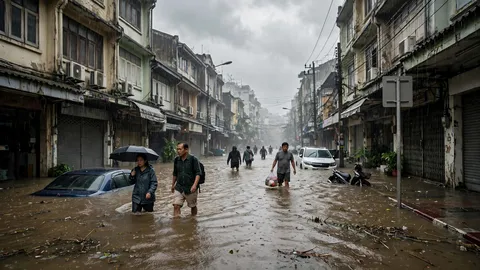
Floods have swamped two of Thailand's most recognisable places — the capital, Bangkok, and the resort island of Phuket — in an autumn of relentless rain that has killed at least 23 people, driven thousands into emergency shelters and caused damage estimated at more than $320 million. In Bangkok, about 320 millimetres of rain fell in two or three days in late September, nearly as much as the low-lying city usually receives in the whole of the month, submerging roads, swamping the drainage network and forcing the declaration of a flood disaster emergency. Six weeks later, the rain returned to the south: on November 2, flash floods hit Phuket's Patong beach district and other parts of the island, and by November 12 the Thai Meteorological Department was warning of heavy to very heavy rain across 14 southern provinces, including Phuket, with further downpours forecast through the middle of the month.
Key points
- Flash floods inundated Phuket and Bangkok, forcing thousands into shelters as damage passed $320 million.
- A city under water
- The $320 million bill
- The rain returns to Phuket
- What happens next
The scale of the September deluge in Bangkok was the worst the city had seen in 15 years. At 10:16 a.m. local time on September 26, after 48 hours of continuous heavy rain, authorities declared a flood disaster emergency, and all 50 of the capital's districts were designated disaster zones. Residents waded through waist-deep water in some areas, entire neighbourhoods were inundated, and thousands of people sought refuge in government evacuation centres. The city's main airport operated in chaos as the flooding spread, and the Bangkok Metropolitan Administration said it would take two to three days to drain the floodwaters once the rain stopped.
A city under water
The rain that drowned Bangkok came from an active low-pressure system and tropical depression combined with strong seasonal monsoon conditions, according to the national meteorological department. The drainage network, built for a city that sits barely above sea level and is crossed by canals, was overwhelmed within hours. Main roads became rivers, and in the worst-hit districts the water rose high enough to strand cars and force residents to move furniture and belongings to upper floors. The flooding was not confined to the capital: by September 26, more than 84,000 people across 21 Thai provinces had been affected, and the count of provinces hit by floods since September 16 eventually reached 41, according to the Interior Ministry.
The human cost mounted quickly. At least eight people had died in flooding across the country by September 28, the Interior Ministry said, and more than 580,000 homes had been disrupted. By September 29, authorities put the death toll at 23, including eight in Samut Prakan, six in Sa Kaeo and four in Bangkok. Thousands of residents remained in shelters as the waters began to recede, and officials warned that the damage figures would keep rising as assessments reached areas that had been cut off. The floods formed part of a wider run of extreme weather across Asia in 2026, and forecasters warned that further heavy rain could follow before the monsoon season ended. Similar scenes played out on the other side of the world, where Cyclone Charles brought flooding to Europe in the same season.
The $320 million bill
The economic damage from the September floods was estimated at at least 11 billion baht — about $327 million — by Aat Pisanwanich, an economist at Rangsit University, who warned that losses would rise unless the situation improved. The University of the Thai Chamber of Commerce put the nationwide impact at about 12.3 billion baht, with damage to the capital itself reaching about 7 billion baht. Another estimate, reported by The Edge, put the damage at $367 million across two dozen provinces. Wholesale and retail businesses in Bangkok were expected to take the brunt of the losses, while industry and agriculture suffered in the provinces.
The flooding is expected to shave 0.3 percentage points off Thailand's economic growth this year, reducing it to 2.1 percent, and to cut third-quarter growth by about 0.5 percentage points to 1.7 percent, according to Aat. The government moved quickly to respond: on September 29, the Cabinet approved more than 4 billion baht — about $119 million — in aid to address the impact of the floods, Prime Minister Anutin Charnvirakul said, and gave the go-ahead to a long-term drainage project costing 160 billion baht. The scale of the disaster recalled the catastrophic southern floods of the previous year, when 630 millimetres of rain fell over three days, killing at least 145 people, inundating more than 33,000 homes and damaging schools, hospitals and highways.
The rain returns to Phuket
Just as Bangkok was drying out, the rain shifted south. On November 2, between 6 p.m. and 8 p.m., a downpour caused flash flooding in parts of Kathu and Mueang Phuket districts. Runoff from the Khao 50 Pi mountain range flooded Na Nai Soi 8 in Patong and nearby roads, and water was reported on Siriraj Road near the Simon Cabaret, on a lane beside Phuket FantaSea in Kamala and on Thepkrasattri Road. Waterlogging was also reported on Pracha Uthit 1 Road in Ratsada, Ban Kuku Road and Soi Phaniang. After the rain stopped, water levels began to recede, but the Thai Meteorological Department issued a second warning of heavy rain and possible renewed flooding, with Phuket among ten provinces identified as at risk.
The warnings kept coming. On November 7, Phuket was included in a forecast for thunderstorms and isolated heavy rain across the south, and the Department of Disaster Prevention and Mitigation issued a flash-flood alert for 16 provinces, including Phuket, covering November 9 to 13. On November 10, the meteorological department warned of heavy to very heavy rain across the south from November 10 to 13, with flash floods, overflowing waterways and landslides possible. The heaviest rain was expected in Chumphon, Surat Thani and Nakhon Si Thammarat, with heavy rain spreading to Phuket, Krabi, Ranong, Trang and Satun from November 12.
On November 12, the department issued Announcement No. 9 at 5 p.m., warning of heavy to very heavy rain and accumulated rainfall across the south on November 12 and 13, with risks of flash floods and run-off, particularly on foothill slopes near waterways and in low-lying areas. Khaosod reported that heavy rain was falling across all three of Phuket's districts — Mueang Phuket, Kathu and Thalang — at 5:40 p.m. that day, and residents were urged to keep watching rainfall and accumulated water, particularly in repeatedly flooded and low-lying areas. Small boats in the lower Gulf of Thailand were advised to remain ashore, and waves of 2 to 3 metres were forecast in the lower Gulf and the Andaman Sea, exceeding 3 metres in thundershowers.
What happens next
On November 14, heavy to very heavy rain was forecast in 13 southern provinces, and the meteorological department expected continuous rain, including scattered heavy to isolated very heavy rain, across the south from November 18 to 22. The department urged people in the south to remain alert, and its next announcements were scheduled through its 24-hour hotline and website. For Bangkok, the immediate task is recovery: damage assessments are expected to be refined in the coming weeks as floodwaters recede further from affected provinces, and the government's 160-billion-baht drainage project is intended to reduce the risk of a repeat.
For the thousands who spent nights in shelters, the floods have already left a lasting mark. Homes, shops and farms across dozens of provinces will take months to repair, and the final damage bill is likely to exceed the early estimates. The season is not over: with more rain forecast for the south and the monsoon still active, Thailand's flood emergency — from the streets of Bangkok to the beach roads of Phuket — remains unfinished. The same pattern of record-breaking weather has battered coastlines elsewhere, as 35-foot waves and flooding hit the Washington coast in the same week, while world leaders gathered to confront a shifting global order at the trilateral summit in Shenzhen.