A Single Router Grounded America: Inside the FAA's Longest Nationwide Ground Stop Since 9/11
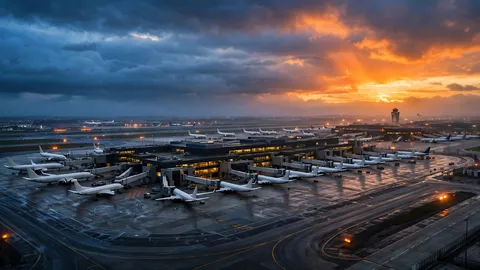
On Friday, November 13, 2026, the United States did something it had not done in a quarter of a century: it stopped flying. The Federal Aviation Administration ordered a nationwide ground stop that lasted nearly five hours, halting departures at airports across the country and canceling more than 18,000 flights, after a newly installed router at a remote communications site in Arkansas flooded a critical government network with connection attempts and destabilized air traffic control communications and radar feeds. It was the longest nationwide ground stop since the September 11 attacks of 2001, and only the second one since then.
Key points
- A faulty router installation triggered a nearly five-hour nationwide FAA ground stop on November 13, canceling more than 18,000 flights.
- What went wrong in El Dorado
- A system held together by aging wires
- The fallout: flights, markets and passengers
- Only the second ground stop since 9/11
The cause, according to U.S. Transportation Secretary Sean Duffy, was not a storm, a cyberattack or a software bug in an air traffic control system. It was a piece of network hardware — a router installed by contractor L3Harris Technologies at an FAA radio communications site in El Dorado, Arkansas — that began hammering a key government communications system with 1,000 connection attempts every four to five seconds. The flood of data destabilized communications and radar feeds at 17 of the FAA's 22 en route centers, the facilities that guide aircraft between airports, and left controllers unable to rely on the systems they use to keep planes safely separated.
With no safe alternative, the FAA grounded the country. Departures stopped nationwide in the mid-afternoon, and the stop was not lifted until Friday evening, when regulators allowed flights to resume at 8:15 p.m. Eastern time. By then, the damage was done: planes were stranded out of position, crews had timed out, and passengers were sleeping on airport floors from coast to coast. The disruption rippled through the weekend as airlines worked to rebuild their schedules, with thousands more flights canceled on Saturday and Sunday before operations returned to normal.
What went wrong in El Dorado
The failure began with a modernization project. L3Harris had been installing new Juniper Networks routers at FAA facilities to replace Cisco routers produced in 2001 — equipment that, according to the FAA, was supposed to have been replaced in 2006. The upgrade was part of a long-running effort to replace the copper-wire backbone of the American air traffic control system with modern fiber and networking gear.
According to Duffy, speaking on CNBC on Monday, November 16, the installation at the El Dorado site triggered the overload. The FAA said on Sunday that its initial investigation suggested the data overload could have originated at two locations: the El Dorado site and a radar site in Amarillo, Texas. Duffy said L3Harris had replaced the router in Amarillo three weeks earlier.
Once the data "inconsistencies" appeared, the FAA said, L3Harris blocked both locations, stabilizing the network. As a precaution, the broadcasting function was disabled on all the newly installed routers. Hewlett Packard Enterprise, which owns Juniper Networks, said on Sunday that the Juniper device was "functioning exactly as intended" based on what it knew at the time — a statement that leaves open the question of whether the fault lay in the hardware, the installation or the way the device was configured for the FAA's network.
What remains unclear, Duffy acknowledged on Monday, is why the router behaved the way it did. The investigation is continuing, and L3Harris has said it is cooperating with officials to determine what went wrong.
A system held together by aging wires
The ground stop exposed, in the most public way possible, the fragility of the infrastructure that guides American aviation. The FAA's air traffic control system still runs on copper-wire networks and equipment that in some cases is decades old. The Cisco routers being replaced date from 2001 and were due for replacement twenty years ago. Controllers and pilots communicate over systems whose underlying telecommunications network has been flagged as a risk for years.
Duffy has used the crisis to press Congress for billions of dollars to build an entirely new network, operated by AT&T, Verizon and Lumen, that would replace the L3Harris-owned system. "I have the architecture ready. These companies are ready to deploy tomorrow. All I need is the money to tell them to start," he said on NBC on Sunday. "I want to get away from L3Harris and get to a new one. But they own the network. So I can't cancel the network that they own and I operate on."
The comment captured an awkward reality at the heart of the failure: the government operates its air traffic control system on a telecommunications network it does not own, maintained by a contractor it is now blaming for the worst disruption to American aviation in 25 years. Duffy said he has urged Congress to fund the construction of a new network not owned by L3Harris — a request that now carries the weight of a nationwide shutdown behind it.
The fallout: flights, markets and passengers
The human cost of the ground stop was measured in stranded travelers. FlightAware data reported by local stations showed 9,938 flights canceled on Friday and 7,352 more on Saturday, with delays piling up into the tens of thousands. On a typical day, roughly 45,000 flights operate across the United States, so the stop erased a significant share of the nation's air travel for an entire weekend. Passengers described sleeping in terminals, rebooking flights days later than planned, and in some cases switching to trains to reach their destinations.
FAA Administrator Bryan Bedford said on Saturday that air travel should be fully recovered by the end of Sunday, adding that the "worst is behind us." By Sunday evening, cancellations had fallen sharply from Friday's peak, though thousands of flights were still delayed as airlines worked to get aircraft and crews back into position.
The financial markets delivered their own verdict on Monday. Shares of L3Harris, the FAA's contractor, fell 3.3 percent after the government blamed the mass flight shutdown on its router installation. Shares of Hewlett Packard Enterprise, which owns Juniper Networks, the maker of the routers L3Harris installed, dropped 4.5 percent. The scale of the disruption also raised questions about airline compensation: passengers and consumer advocates began pressing for reimbursement of hotel stays, meals and ground transportation, and a petition demanding accountability and compensation for stranded travelers began circulating within days.
Only the second ground stop since 9/11
To understand the scale of the event, it helps to know how rare a nationwide ground stop is. The last one before Friday was in January 2023, when a corrupted database file forced the FAA to halt departures for less than two hours. Before that, the only nationwide halt was the three-day closure of civilian airspace after the September 11, 2001 attacks. Friday's stop — nearly five hours — was the longest since then, and the first to be caused by a piece of network equipment rather than a security emergency or a software failure in a core FAA system.
The comparison is not merely historical. The 2023 outage, caused by a contractor accidentally deleting files in the system that sends safety notices to pilots, prompted a round of promises about modernizing the FAA's technology. The 2026 ground stop shows how little of that modernization has actually reached the communications network that controllers depend on — and how a single point of failure in a remote Arkansas facility can ground an entire country.
What happens next
Three questions now hang over the FAA. First, the investigation must establish precisely why the router flooded the network — whether it was a configuration error, a hardware fault or a flaw in the upgrade procedure — and whether the same risk exists at other sites where the new routers have been installed. Second, Congress must decide whether to fund the new telecommunications network Duffy is requesting, and how quickly. Third, the FAA must decide what to do about its dependence on a contractor-owned network that its own secretary says he wants to escape.
None of those questions will be answered quickly. The investigation is in its early stages, and the funding request — described by Duffy as running into the billions of dollars — will have to compete with other priorities in a Congress that has heard warnings about the FAA's aging systems for years without acting on them at the scale officials say is needed. The same week the skies went quiet, Democrats swept the 2026 midterm elections, reshaping the political landscape in which that funding fight will now play out.
For travelers, the immediate crisis is over: flights are flying, schedules are restored, and the backlog has cleared. But the episode has left a lasting image — of the world's largest aviation system brought to a standstill by a single router in a small Arkansas town — and a lasting question about how much longer the country can keep flying on infrastructure built for a different century. The same Friday that grounded the nation's planes, storms battered the Washington coast with 35-foot waves, a reminder that the country's infrastructure is being tested on more than one front at once. And as tensions continue to disrupt global shipping lanes — tankers were hit by mines near the Strait of Hormuz just days earlier — the ground stop is the latest sign that the systems the world depends on are more fragile than they look.