Three Tankers Ablaze After Hitting Mines in the Strait of Hormuz
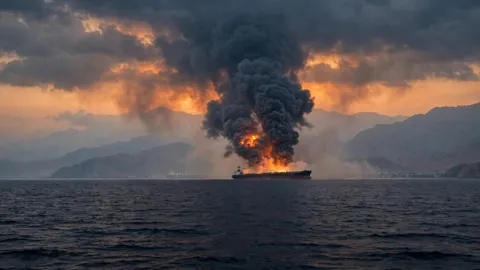
Three oil tankers caught fire after striking naval mines in the Strait of Hormuz on Saturday, Iran's navy and its Revolutionary Guards said, in the latest escalation of a maritime campaign that has turned the world's most important oil chokepoint into a war zone. One tanker hit a mine in the eastern part of the strait on Saturday morning, Iranian state media reported, and two more struck mines later in the day while trying to cross on what Tehran called a prohibited route. No vessel was named, no casualties were reported, and Reuters said it could not immediately verify the accounts.
Key points
- Three oil tankers caught fire after hitting naval mines in the Strait of Hormuz, Iran said, as the UN reported 134 incidents and 25 seafarers killed since February.
- Three tankers, one day
- A campaign that began in February
- Oil markets shrug — for now
- What happens next
The claims landed a day after the United Nations told the Security Council that 134 confirmed incidents had been recorded around the strait since February, killing 25 seafarers, according to figures from the International Maritime Organization. October was the worst month yet, the UN said, with the highest incident count since the crisis began. The pattern is now unmistakable: a waterway that carries roughly a fifth of the world's oil is being fought over ship by ship, and the toll is rising even as oil prices drift lower.
Three tankers, one day
According to Iran's IRNA news agency, the Revolutionary Guards Navy said two tankers — one of them a supertanker — exploded and caught fire on Saturday after striking naval mines while attempting what Tehran described as an unauthorised transit of the southern strait. The vessels had switched off their radar and automatic identification systems, the Guards said, and were trying to slip through a prohibited route. A third tanker had hit a mine in the eastern strait earlier in the day, Iran's navy said, and was left immobilised and burning.
The navy warned that any tanker entering the restricted zone east of the strait would face the same fate, and accused vessel owners of risking their ships by relying on assurances from US President Donald Trump. "It is regrettable that tanker owners, without learning from the fate of other rogue vessels, trusting the nonsense of the criminal US president, are sending their capital to the mine war and throwing it into the fire," the navy's public relations department said, according to the state news agency ISNA.
The claims could not be independently confirmed. Reuters reported that it could not immediately verify the reports, and no tanker was identified by name, flag or owner. The US military says it has cleared the main routes through the strait of mines, and US forces have continued escorting tankers along the southern route, CBS reported on November 12. Satellite fire readings over the strait showed no heat at sea in 16 passes between November 13 and 14, although the same readings also missed a strike that the UK Maritime Trade Operations office did confirm on November 11 — a reminder that absence of evidence is not evidence of absence in a strait where most vessels now sail dark, with their transponders switched off.
A campaign that began in February
The mine incidents are the latest chapter in a conflict that began on February 28, when the United States and Israel launched a military campaign against Iran. Tehran responded by imposing strict restrictions on the strait, requiring prior authorisation for passage and confining safe transit to designated northern corridors, while attacking ships it says violate those rules. The strait, a narrow passage between Iran and Oman, carries about a fifth of global oil deliveries, and the fighting has cut traffic through it to a fraction of normal levels.
The scale of the campaign is becoming clearer. The Washington Institute for Near East Policy said at least 10 vessels were hit during the first 10 days of November alone, according to Reuters. The UN briefing on Friday put the total at 134 confirmed incidents since February, with 25 seafarers killed — figures compiled by the International Maritime Organization and presented to the Security Council by Assistant Secretary-General Khaled Khiari. October, the UN said, recorded the highest monthly incident count since the crisis began.
The confrontation is not confined to the water. Iran's Revolutionary Guards claimed their aerospace force had destroyed a US early-warning radar installation in Bahrain, in retaliation for an alleged American attack on telecommunications infrastructure in Iran's Sirik region. US Central Command rejected the claim, saying two Iranian attack drones launched toward Bahrain had been shot down by US forces, with no injuries or damage. "The IRGC launched two one-way attack drones toward Bahrain, and both were shot down by US forces. There were no injuries or damage," CENTCOM said in a post on X.
Oil markets shrug — for now
Remarkably, oil markets have barely reacted to the latest incidents. Brent crude settled at $95.84 a barrel on Friday, November 13 — up just two cents on the day and on course for a second consecutive weekly fall, according to Reuters. That is well below the late-October peak of about $118 a barrel, and only about a third higher than the roughly $72 a barrel Brent traded at before the war began. The International Energy Agency said on November 13 that October was the oil market's first surplus since the war began, as Gulf exports recovered and buyers found workarounds.
The calm in crude prices masks strain elsewhere. Shipping insurance for Gulf routes has quintupled since March, according to Lloyd's List data cited by Reuters, and cargo owners now face freight surcharges of $12 to $18 a tonne for voyages through the strait. Diesel, not crude, is where the war's cost is showing up: New York Harbor diesel traded about $84 a barrel above Brent on November 11, against about $28 in January. And the physical flow of oil remains disrupted — ship-tracking data showed only nine vessels transiting the strait on November 13, against a pre-crisis norm of about 88 a day, with Kpler putting Hormuz crude traffic at an average of 10.5 million barrels a day since October 1, against about 13.5 million before the war.
The muted market reaction may also reflect a belief that the conflict is heading toward a pause rather than an escalation. President Trump has told senior advisers in recent days that he may hold off on attacking Iran if the United States faces no new provocations from Tehran or the Iran-backed Houthis in Yemen, according to three people familiar with the matter, Reuters reported on November 14. Trump has alternated between threats of escalating the war with new strikes and winding down hostilities, and officials say he does not appear to have made up his mind. A third aircraft carrier is moving into the Middle East in the coming days to replace one of the two currently operating there, but all three could stay if needed.
What happens next
The immediate question is whether Saturday's incidents count as the kind of provocation that changes Trump's calculus. The war has already proved unpopular with American voters — in a Reuters/Ipsos poll taken shortly before the November 3 elections, 55 percent of Americans said the war was a mistake, and voters handed control of Congress to the Democrats in last week's midterms, a result driven in part by anger over fuel prices and the cost of the conflict. The Democratic sweep has strengthened the political case for restraint, even as the military build-up continues.
Diplomacy, meanwhile, has not stopped. Trump has spoken by phone with the leaders of Saudi Arabia and Turkey, and an official readout from the November 7 call stressed that tensions between Iran and the United States need to end. US intelligence agencies have assessed that the naval blockade and economic sanctions are hurting the Iranian economy and would continue to put pressure on Tehran, according to two US officials briefed on the intelligence. The United States is also seeking to prevent weapons and other sanctioned material from entering Iran by land or through the Caspian Sea, building on its months-long blockade of Iranian sea traffic.
For the shipping industry, the outlook is bleak either way. Until the mines are cleared and the restrictions lifted, every transit through the strait is a gamble — and the UN's figures show the gamble is getting deadlier. Twenty-five seafarers have already been killed, and October's record incident count suggests the campaign is intensifying, not winding down. The next test comes in the days ahead: whether the tanker traffic that trickles through the strait each day — nine vessels on the latest count — keeps moving, and whether the oil market's calm survives the next claim of a ship on fire. The war that began in February has already reshaped the global energy map, and the trilateral summit in Shenzhen showed that the world's great powers are now negotiating a new order around it. For now, the strait remains open in name and closed in practice — and the price of that contradiction is measured in burning tankers, soaring insurance rates, and a market that has learned to look the other way. Investors in other markets have felt the same whiplash this week, as Bitcoin crashed below $67,000 on the same wave of geopolitical fear.